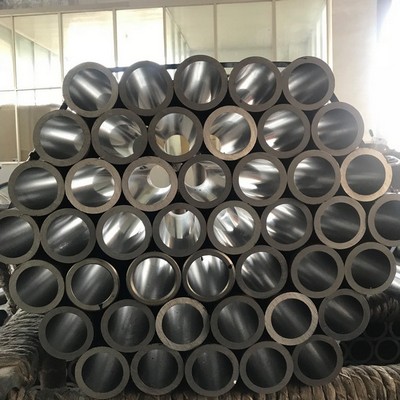
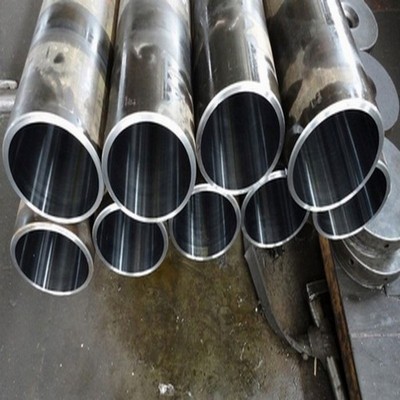
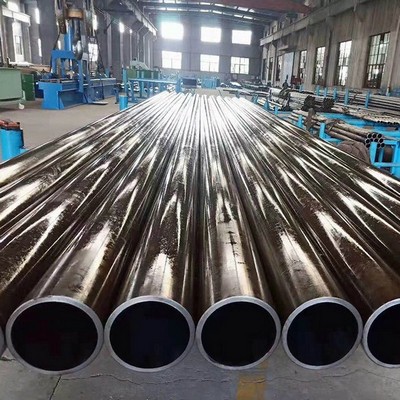
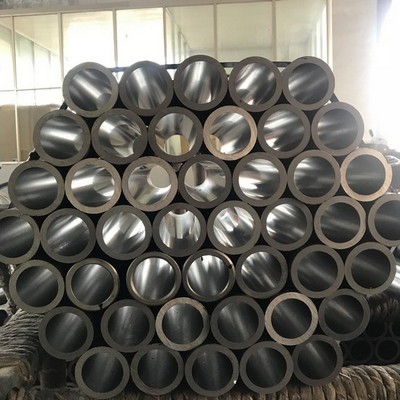
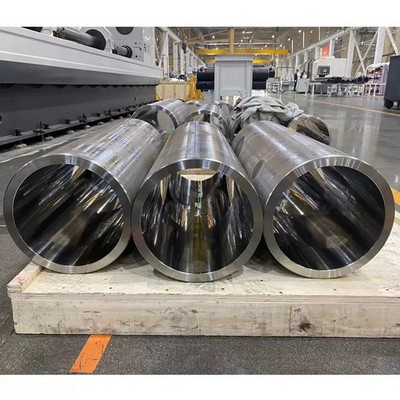
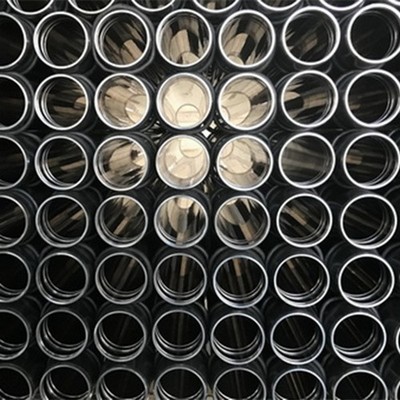
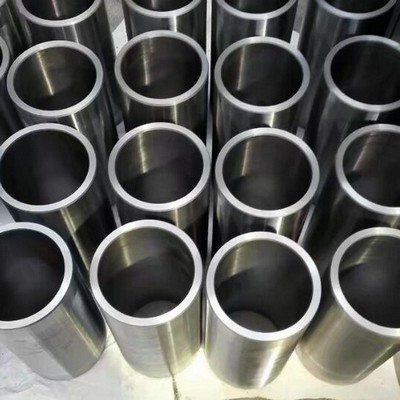
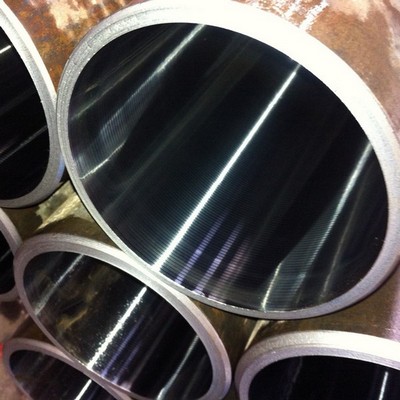
Honing, also known as boring, is the finishing process of finishing surfaces with an oil stone (also known as a honing bar) set in the honing head.
Brief introduction
It mainly processes various cylindrical holes with diameters from 5 to 500 mm or even larger, and the ratio of hole depth to hole diameter can be 10 or larger. Under certain conditions, it can also process flat surface, external circular surface, spherical surface, tooth surface, etc. The honing head is set with 2~10 oil stones of length about 1/3~3/4 of the hole length around the outer circumference, and it has both rotating movement and round-trip movement when honing the hole, and at the same time, it rises evenly through the spring or hydraulic control in the honing head, so the contact area with the hole surface is larger and the processing efficiency is higher. The size accuracy of the hole after honing is IT7~4, and the surface roughness can reach Ra0.32~0.04 micron. The size of honing allowance depends on the hole diameter and workpiece material, generally 0.02~0.15 mm for cast iron parts and 0.01~0.05 mm for steel parts. The speed of honing head is generally 100-200 rpm, and the speed of round-trip movement is generally 15-20 m/min. In order to flush away the chips and abrasive particles, improve the surface roughness and reduce the temperature of the cutting area, the operation often requires a large amount of cutting fluid, such as kerosene or a small amount of ingot oil inside, and sometimes extreme pressure emulsion is also used.
Method
When honing, the workpiece is mounted on the honing table or in the fixture, and the honing head with a number of oil stone strips is inserted into the processed hole, driven by the machine tool spindle to rotate and make axial reciprocating movement. The oil stone strips contact with the hole wall with certain pressure to cut off a very thin layer of metal. The honing head and the spindle are generally floating coupling.
② Honing head has several kinds of mechanical pressurized, pneumatic or hydraulic automatic pressure regulating type. The honing head shown in the figure is mechanical pressurized type, and the hydraulic pressure regulating type is mostly used in actual production.
Process characteristics
① Honing is an efficient processing method to make the surface of workpiece reach high precision, high surface quality and high life, which can effectively improve the dimensional accuracy, shape accuracy and reduce Ra value, but cannot improve the position accuracy of hole and other surfaces.
②It can process cast iron parts, hardened and unhardened steel parts and bronze parts, but it is not suitable for processing tough non-ferrous metal parts. , ③
③ Honing is mainly used for hole processing. In the hole honing processing, it is guided by the original processing hole center. The processing hole diameter range is φ5~φ500, and the depth-diameter ratio can reach 10.
④ Honing is widely used for processing cylinder holes, cylinder barrels, valve holes and many kinds of gun barrels in mass production. It can also be used in single piece small batch production.
⑤ Coaxiality cannot be determined when honing.
⑥Compared with grinding, honing has the characteristics of reducing the physical labor of workers, high productivity, and easy to realize automation.
Use
Finishing process of finishing surface with oil stone (also called honing strip) set on honing head (see cutting process). Honing is mainly used for processing various cylindrical holes with a diameter of 5 to 500 mm or larger, such as cylinder barrels, valve holes, connecting rod holes and box holes, etc. The ratio of hole depth to hole diameter can reach 10, or even larger. Under certain conditions, honing can also process the outer circle, flat surface, spherical surface and tooth surface, etc. The surface roughness of cylindrical honing is generally up to Ra0.32~0.08 microns, and that of fine honing is up to Ra0.04 microns or less, and can improve the geometric accuracy by a small amount, and the machining accuracy is up to IT7~4. The surface quality of flat honing is slightly poor.